Loading…
Careers · Aerospace
Works out what the structure actually feels in flight, not just what it feels sitting still.
The work
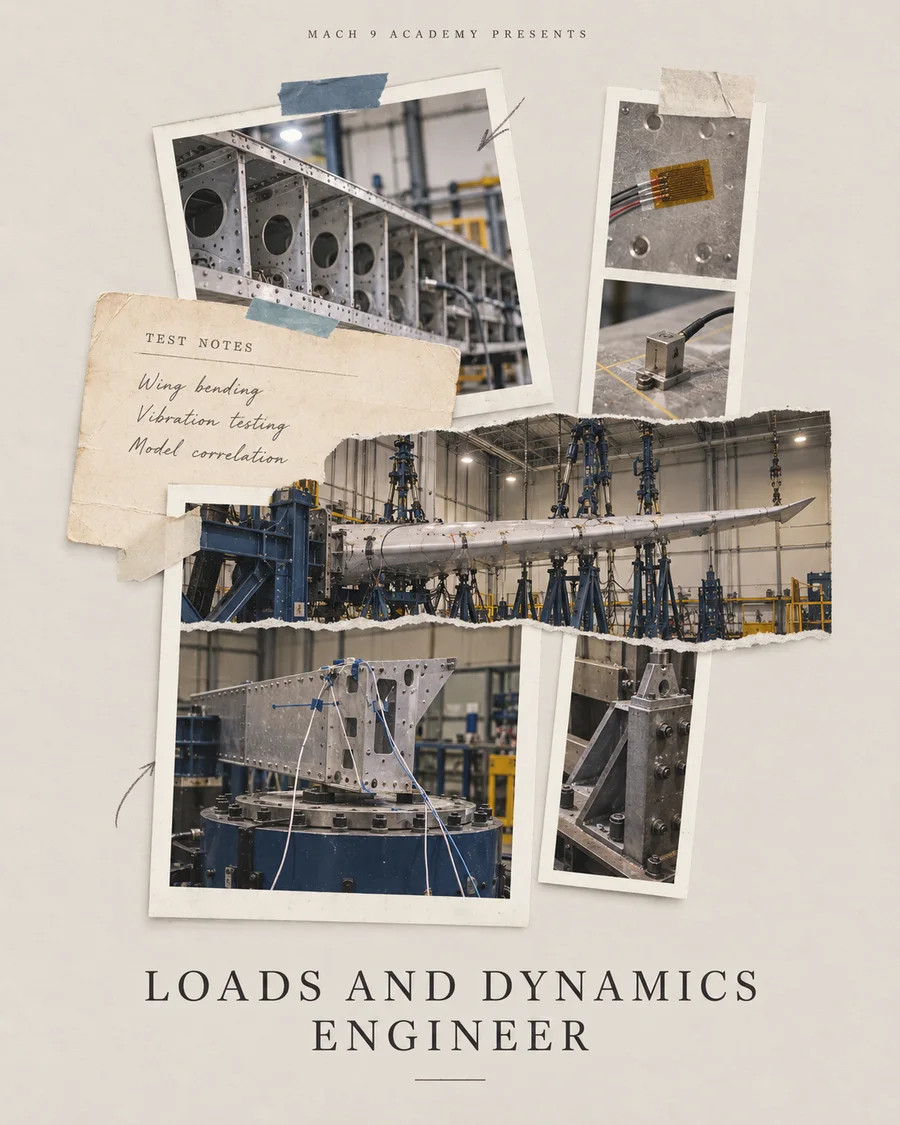
A structure that survives a static load can still fail if it vibrates at the wrong frequency, or if an aerodynamic surface flexes enough to feed energy back into the airflow that is bending it, flutter, which can tear a wing off in seconds once it starts. Loads and dynamics engineers combine the aerodynamic loads, the structural stiffness and the mass distribution into models that predict how the whole vehicle moves, and set the flight envelope the rest of the programme has to stay inside.
A typical day
- 01Build finite element and aerodynamic models of the whole vehicle
- 02Run flutter and vibration analysis against the flight envelope
- 03Support ground vibration testing and correlate the model against it
- 04Monitor structural response during early flight test
How people get in
- Aerospace engineering degree
The standard route, ideally with a structural dynamics or vibrations course beyond the core curriculum.
How it unfolds
- DegreeAerospace engineering, with structural dynamics and vibration taken past the introductory course.
- Years 1-3Building loads models and running them against defined flight and ground cases.
- Years 4-8Clearing the flight envelope: proving the vehicle will not flutter anywhere it is meant to fly.
- LaterDynamics lead, or into flight test as the person who reads the vibration data live.
Is there a job in it
- Employed now
- 68,700
- Projected change
- +8% by 2034
- Openings a year
- 3,800
Aerospace engineers · US Bureau of Labor Statistics, Occupational Outlook Handbook, May 2024 wages and 2024–34 projections.
Counted inside "aerospace engineers" along with every other discipline that designs air and space vehicles. Loads and dynamics, and flutter specifically, are not broken out as their own line.
The hard parts
Flutter is a genuinely dangerous failure mode, it can happen suddenly and destructively once the airspeed crosses a threshold your model said was safe. Ground vibration tests are slow and expensive to set up correctly, and a model that is subtly wrong looks exactly like one that is right until someone flies past the number it predicted.
What you would need
- Structural dynamics
- Aeroelasticity
- Finite element analysis
- Signal processing
- Median pay
- $134,960
- Aerospace engineers, May 2024. US Bureau of Labor Statistics.
- Typical education
- Bachelor's or Master's in aerospace engineering
- Routes in
- Degree
- Field
- Aerospace