Loading…
Careers · Aerospace
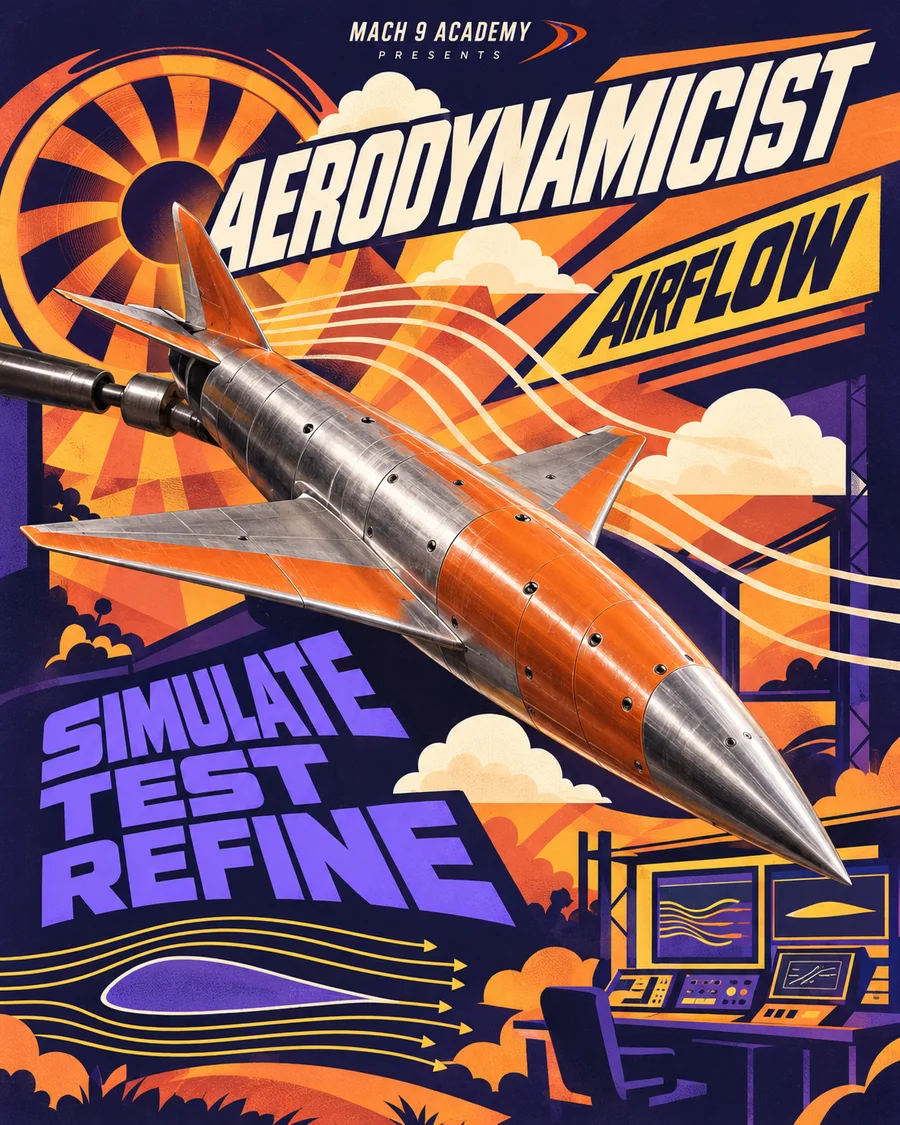
Works out how the air will behave around a shape before anyone commits to building it.
The work
An aerodynamicist predicts lift, drag and pressure distribution with computational fluid dynamics, then spends a good part of the job finding out where the simulation was wrong. Wind tunnel time is booked months ahead and costs real money per run, so a test campaign is designed to answer the fewest, sharpest questions it can. The discipline splits by speed regime, subsonic, transonic, supersonic, hypersonic each break a different assumption in the same code.
A typical day
- 01Set up and run CFD cases across a speed range
- 02Compare predictions against wind tunnel or flight test data
- 03Build the aerodynamic database a controls or performance team designs against
- 04Chase down why a simulation and a test disagree
How people get in
- Aerospace engineering degree
The standard route. A course with real CFD and wind tunnel lab time matters more than the ranking.
- University rocketry or aero teams
Building and flight-testing something yourself is a stronger signal than a transcript, and employers know it.
How it unfolds
- DegreeAerospace engineering, with fluid mechanics and numerical methods taken as far as the course goes.
- Years 1-3Running CFD cases someone else set up, and learning where a mesh is lying to you.
- Years 4-8Owning the aerodynamic database for a vehicle or a flight regime, and defending it against test data.
- LaterAerodynamics lead, or across into flight test.
Is there a job in it
- Employed now
- 68,700
- Projected change
- +8% by 2034
- Openings a year
- 3,800
Aerospace engineers · US Bureau of Labor Statistics, Occupational Outlook Handbook, May 2024 wages and 2024–34 projections.
Counted inside "aerospace engineers" along with every other discipline that designs air and space vehicles. Aerodynamics is not broken out as its own line, and neither is which speed regime somebody actually works in.
The hard parts
A simulation is not trusted until it agrees with a physical test, and the physical test is expensive and booked out, so a bad tunnel entry costs real money and real schedule. The three speed regimes this field lives in each break a different assumption in the same solver, and working out which one is lying to you this time is most of the actual skill.
What you would need
- Fluid mechanics
- Computational fluid dynamics
- Wind tunnel testing
- Numerical methods
- Median pay
- $134,960
- Aerospace engineers, May 2024. US Bureau of Labor Statistics.
- Typical education
- Bachelor's or Master's in aerospace engineering
- Routes in
- Degree
- Field
- Aerospace