Loading…
Careers · Aerospace
Builds and instruments the hardware that engineers only ever see as a report.
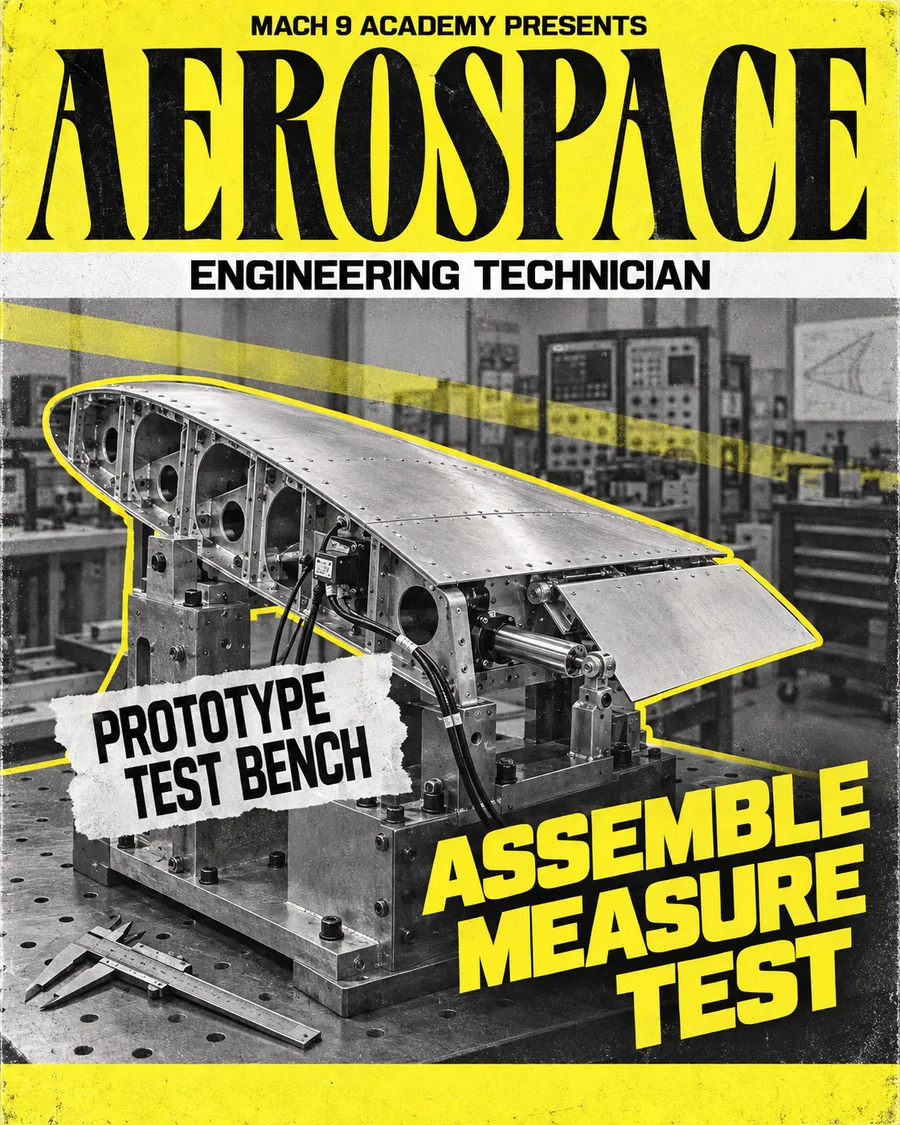
The work
Somebody has to build the test article, wire in the strain gauges and pressure taps, and get a rig running before an engineer’s analysis can be checked against anything real. Aerospace engineering technicians do that: fabricating and modifying prototypes, setting up instrumentation, and operating the test equipment that turns a design into data. It is a licensed, well-paid trade that does not require a four-year degree.
A typical day
- 01Fabricate or modify a test article from engineering drawings
- 02Install strain gauges, pressure taps and other instrumentation
- 03Set up and operate test rigs and data acquisition systems
- 04Flag a drawing or a tolerance that does not survive contact with the real part
How people get in
- Associate’s degree
Aerospace, mechanical or manufacturing technology programmes feed this role directly, in about two years.
- Employer apprenticeship
Several aerospace primes and test facilities train technicians on the job, paid from day one.
How it unfolds
- TrainingAn associate’s programme or an employer-run apprenticeship in aerospace or mechanical technology.
- Years 1-3Building test articles and instrumentation under a senior technician or engineer.
- Years 4-8Running your own builds and rigs, and being the person a design review trusts to say whether it is actually makeable.
- LaterLead technician, or across into a design or manufacturing engineering role.
Is there a job in it
- Employed now
- 11,600
- Projected change
- +12% by 2034
- Openings a year
- 1,100
Aerospace Engineering and Operations Technologists and Technicians · US Bureau of Labor Statistics, Occupational Outlook Handbook, May 2024 wages and 2024–34 projections.
The hard parts
You build to a drawing that was not written with your hands in mind, and you are the one who finds out where it does not quite work. Test schedules are set by engineers and programme managers, and the article is often needed faster than it can honestly be built. The work is genuinely physical, and a rig has to be exactly right before anyone trusts the data that comes out of it.
What you would need
- Precision fabrication
- Instrumentation
- Reading engineering drawings
- Test equipment operation
- Median pay
- $82,890
- Aerospace Engineering and Operations Technologists and Technicians, May 2024. US Bureau of Labor Statistics.
- Typical education
- Associate's degree or technical training in aerospace or mechanical technology
- Routes in
- Apprenticeship, Licence or certification
- Field
- Aerospace