Loading…
Careers · Technology
Turns a company’s raw data into the model that decides what happens next.
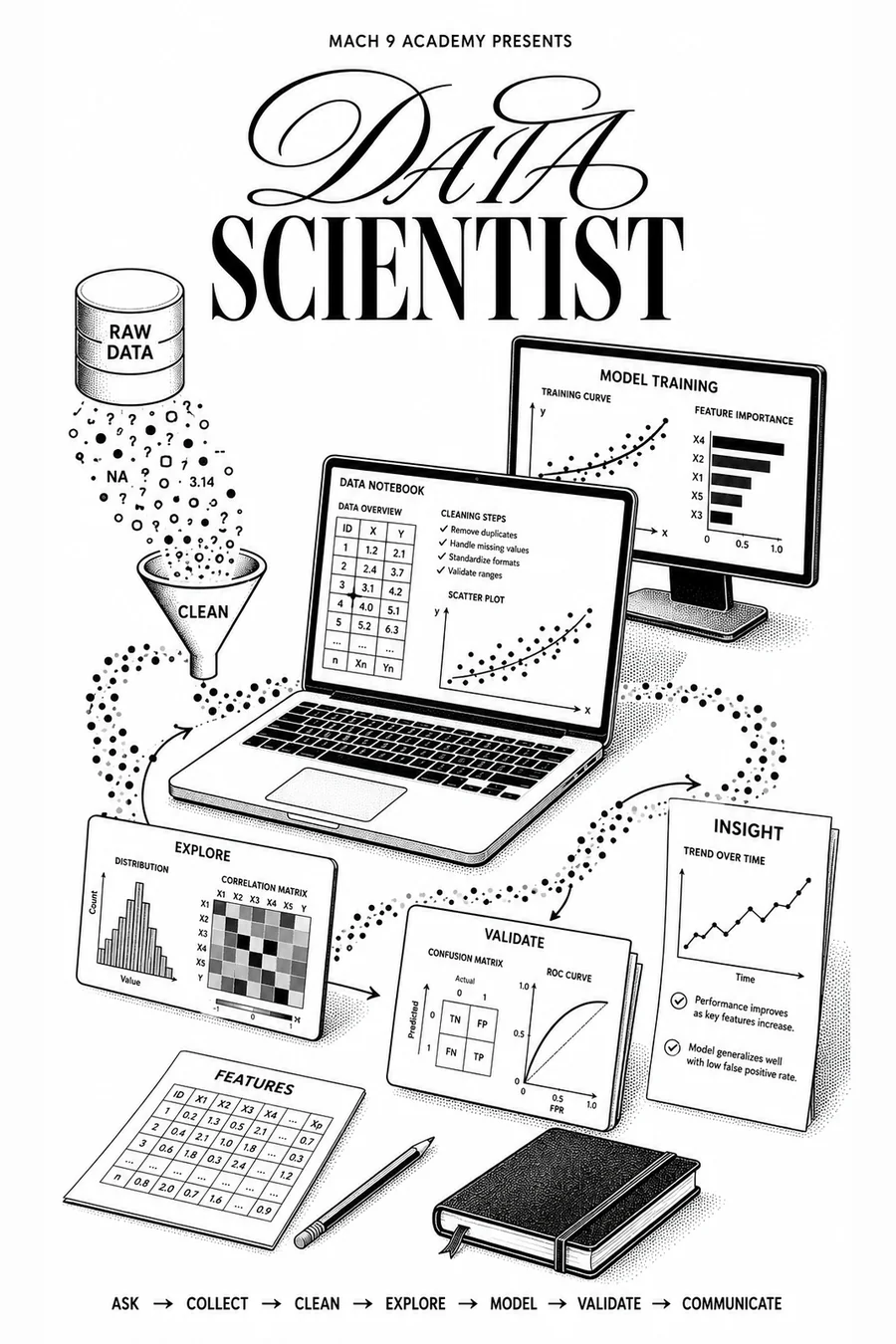
The work
A data scientist sits between statistics and software: building models that predict, classify or recommend, then getting them running somewhere they actually affect a decision. The job is less about the model than about the questions before it, what you are actually trying to predict, and whether the data you have can answer that honestly.
A typical day
- 01Clean and explore a dataset before trusting it
- 02Build, test and validate a predictive model
- 03Communicate uncertainty to people who want a single number
- 04Monitor a deployed model for drift over time
How people get in
- Quantitative degree
Statistics and computer science are the most direct routes; physics, economics and applied maths all work too.
How it unfolds
- DegreeStatistics, computer science, maths or a science with heavy quantitative work.
- Years 1-3Building and validating models against a well-defined problem someone else scoped.
- Years 4-8Scoping the problem yourself, and owning a model that a real decision runs on.
- LaterPrincipal data scientist, or into machine learning engineering.
Is there a job in it
- Employed now
- 275,600
- Projected change
- +35% by 2034
- Openings a year
- 24,800
Data scientists · US Bureau of Labor Statistics, Occupational Outlook Handbook, May 2024 wages and 2024–34 projections.
The hard parts
Most of the job is not modelling, it is cleaning and understanding data nobody documented properly, and it is common to spend weeks proving a promising idea does not actually hold up. A model that is subtly wrong is worse than one that visibly fails, because nobody notices until it has already made bad decisions.
What you would need
- Statistics
- Python or R
- SQL
- Explaining uncertainty plainly
- Median pay
- $120,230
- Data scientists, May 2024. US Bureau of Labor Statistics.
- Typical education
- Bachelor's in statistics, computer science, mathematics or a related quantitative field
- Routes in
- Degree
- Field
- Technology