Writes the code that has to work the first time, every time.
The work
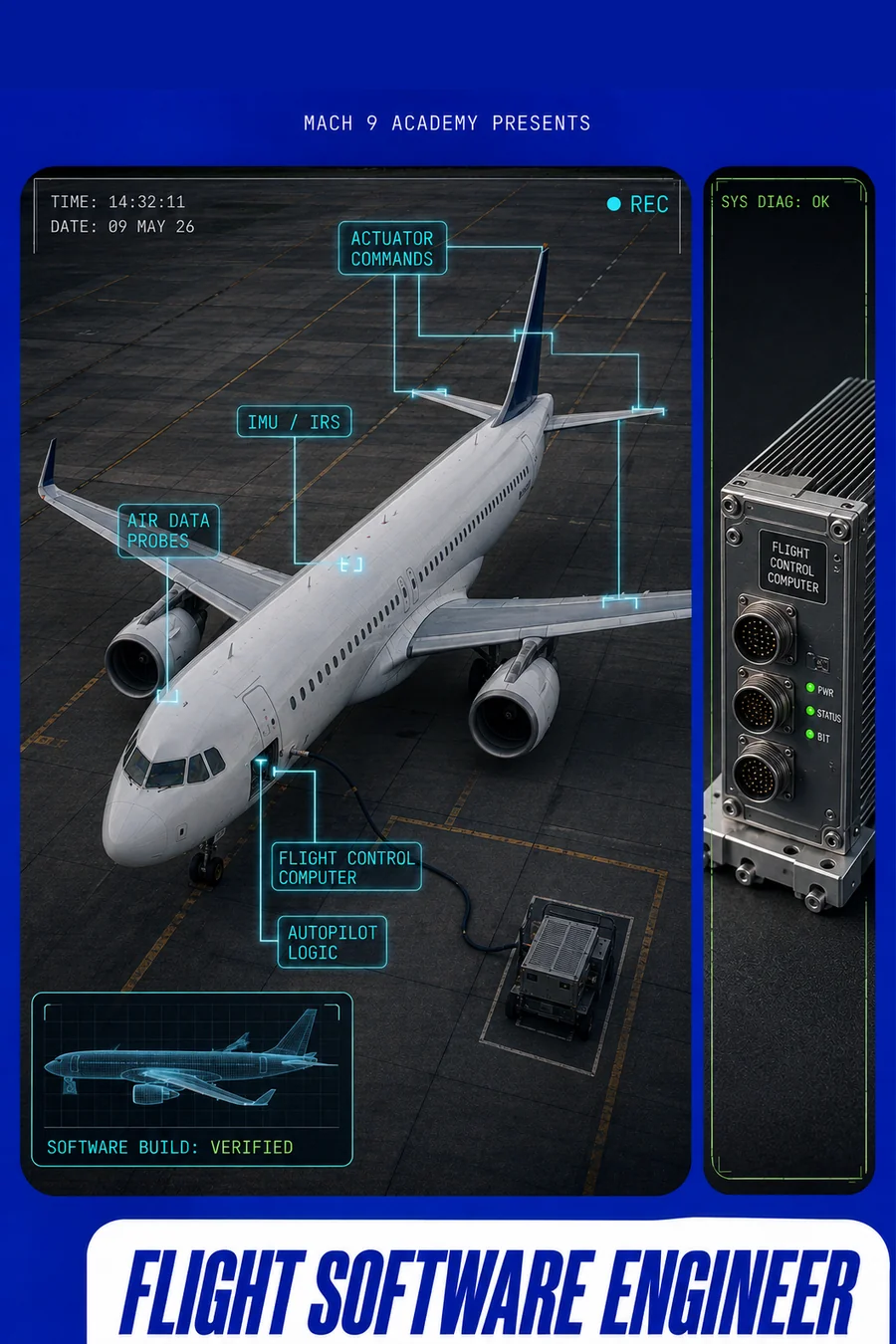
Flight software runs the vehicle. It is written against strict standards, reviewed line by line, tested on representative hardware, and deliberately conservative, no dynamic allocation after boot, no surprises. It is also one of the most accessible routes into aerospace for someone who already writes code.
A typical day
- 01Implement and review flight-critical modules
- 02Run tests on hardware-in-the-loop rigs
- 03Trace every requirement to a test that proves it
- 04Debug something that only happens once every ten thousand cycles
How people get in
- Computer science or engineering degree
The common route. Embedded and robotics projects count for a lot.
- Self-taught plus portfolio
Harder, but real: demonstrable embedded work on real hardware opens doors.
How it unfolds
- DegreeComputer science or engineering, with real depth in low-level programming.
- Years 1-3Test software and tooling. Flight code is not where anybody starts.
- Years 4-8Flight software for a subsystem, under a standard with an auditor behind it.
- LaterSoftware architect, or safety and certification.
Is there a job in it
- Employed now
- 1,905,400
- Projected change
- +10% by 2034
- Openings a year
- 106,100
Software developers, quality assurance analysts, and testers · US Bureau of Labor Statistics, Occupational Outlook Handbook, May 2024 wages and 2024–34 projections.
Counted inside software development as a whole. Safety-critical flight software is a very small and unusually regulated corner of an occupation of nearly two million people.
The hard parts
Coding standards, reviews and traceability slow everything down and exist because the alternative has been tried. There is no patch after launch on most of these vehicles. The discipline required is closer to structural engineering than to web development.
What you would need
- C and C++
- Real-time systems
- Verification
- Version control
- Median pay
- $134,040
- Software developers, quality assurance analysts, and testers, May 2024. US Bureau of Labor Statistics.
- Typical education
- Bachelor's in computer science, software or electronic engineering
- Routes in
- Degree, Licence or certification
- Field
- Technology