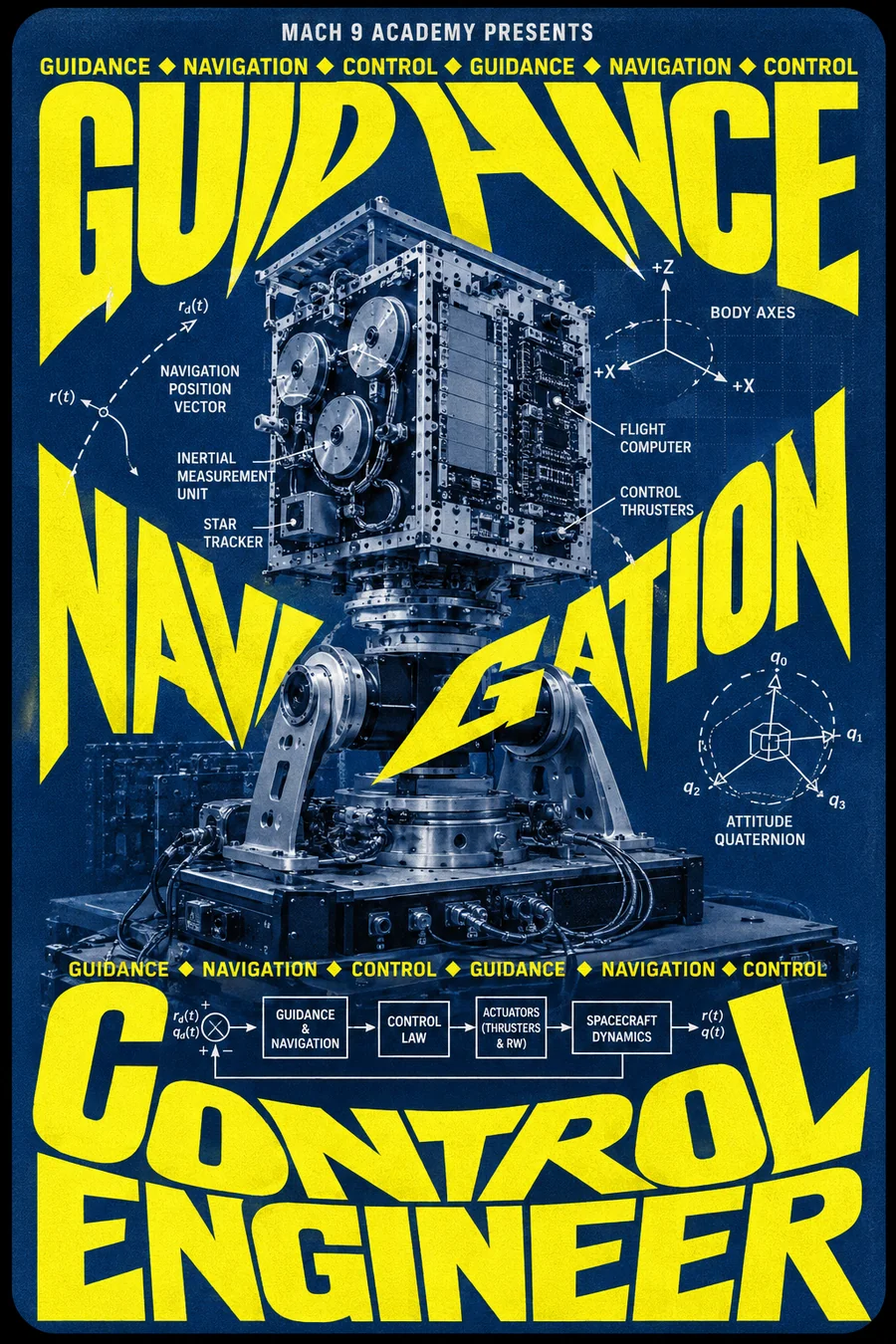
Designs the loops that decide where the vehicle points and goes.
The work
GNC turns sensor readings into actuator commands. The same discipline holds an airliner on altitude, points a telescope, and lands a booster on a barge, the difference is the plant, not the mathematics.
A typical day
- 01Model vehicle dynamics and design controllers
- 02Analyse stability margins across the envelope
- 03Run Monte Carlo simulation campaigns
- 04Support flight test and tune against real data
How people get in
- Engineering degree with control emphasis
Aerospace, electrical or mechatronics. A postgraduate course is common but not required.
How it unfolds
- DegreeAerospace, control engineering or applied maths. Control theory is the whole subject.
- Years 1-3Simulation and analysis. Modelling the vehicle before anybody flies it.
- Years 4-8Designing the loops, tuning them, and proving stability across the envelope.
- LaterGNC lead, or autonomy and estimation research.
Is there a job in it
- Employed now
- 68,700
- Projected change
- +8% by 2034
- Openings a year
- 3,800
Aerospace engineers · US Bureau of Labor Statistics, Occupational Outlook Handbook, May 2024 wages and 2024–34 projections.
Counted inside "aerospace engineers", along with every other engineering discipline that works on air and space vehicles. There is no separate published line for this specialism.
The hard parts
The maths does not let up, and a controller that works in simulation and not in flight is a career-defining problem to debug. Sensor noise, delays and unmodelled dynamics are where the real work is.
What you would need
- Control theory
- Estimation and filtering
- Simulation
- Applied linear algebra
- Median pay
- $134,960
- Aerospace engineers, May 2024. US Bureau of Labor Statistics.
- Typical education
- Bachelor's or Master's in control, aerospace or electrical engineering
- Routes in
- Degree
- Field
- Technology