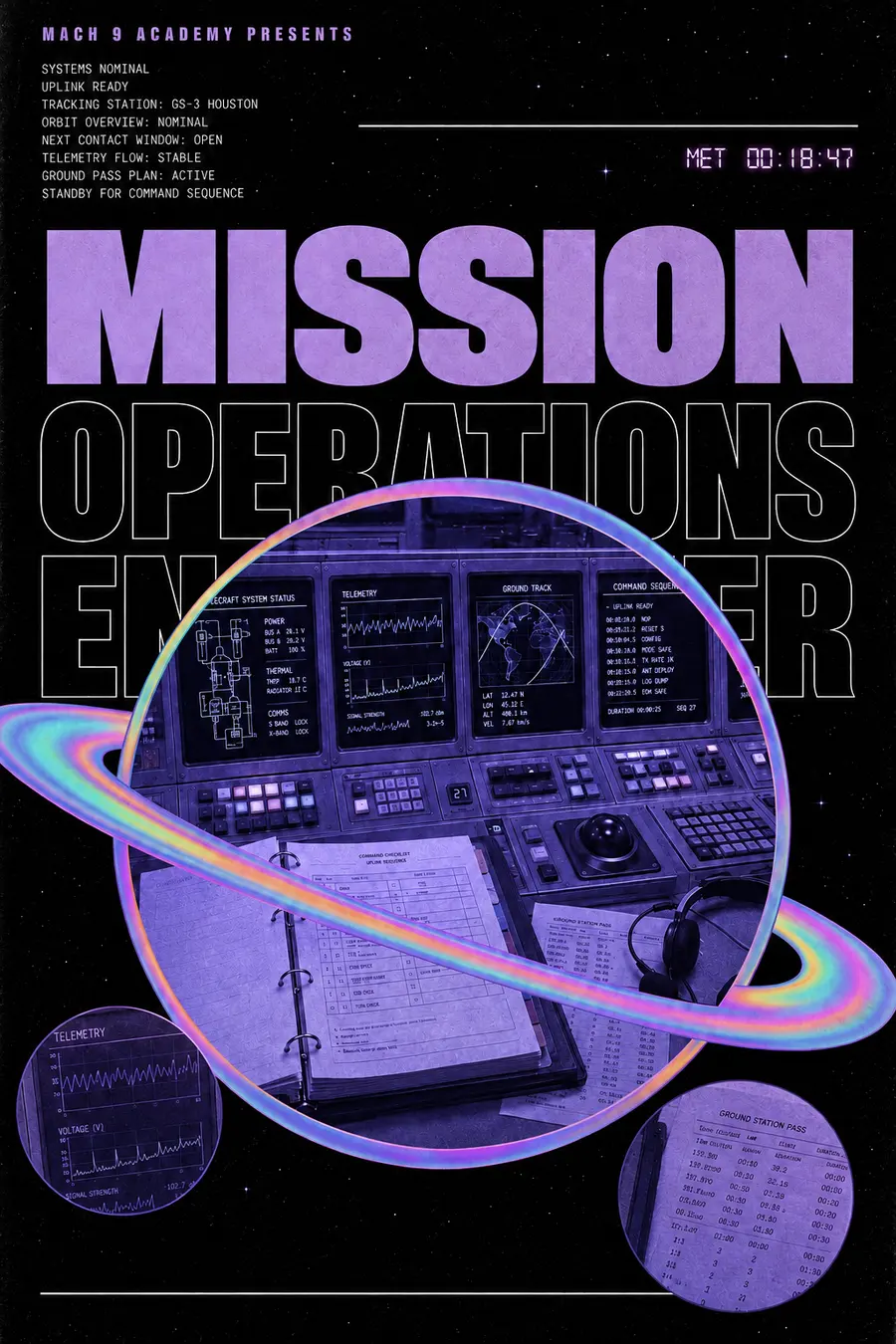
Flies the spacecraft after launch and responds when something goes wrong.
The work
Operations begins where the build ends. You monitor telemetry, plan and uplink command sequences, work anomalies against procedures written years earlier, and hand over to the next shift because spacecraft do not sleep.
A typical day
- 01Monitor spacecraft health and trend telemetry
- 02Build, validate and uplink command sequences
- 03Run simulations against the flight rules
- 04Work anomalies with the subsystem specialists
How people get in
- Engineering or science degree
Broad entry. Simulation and ground-segment internships are the usual way in.
How it unfolds
- DegreeEngineering or physics, and often a first job somewhere else in the programme.
- Years 1-3Console operator on a shift rota. Procedures, telemetry, and simulations of things going wrong.
- Years 4-8Lead operator or flight controller for a subsystem, certified on the position.
- LaterFlight director, or operations lead on a new mission.
Is there a job in it
No published projectionSpaceflight operations is not a published occupation. It is small, concentrated in a handful of agencies and companies, and the Handbook has no entry for it, so this profile quotes no figure rather than borrowing one from aerospace engineering.
The hard parts
Missions do not observe office hours and neither do anomalies. Much of the job is training for events that may never happen, and the ones that do happen arrive at three in the morning with a spacecraft that is not answering.
What you would need
- Systems thinking
- Scripting
- Procedure discipline
- Shift-work stamina
- Median pay
- $112K
- Not sourced No published occupation matches this role. See the demand section below.
- Typical education
- Bachelor's in engineering, physics or computer science
- Routes in
- Degree, Military
- Field
- Space