Loading…
Careers · Engineering
Works out how something is likely to fail before it does, and what to do about it.
The work
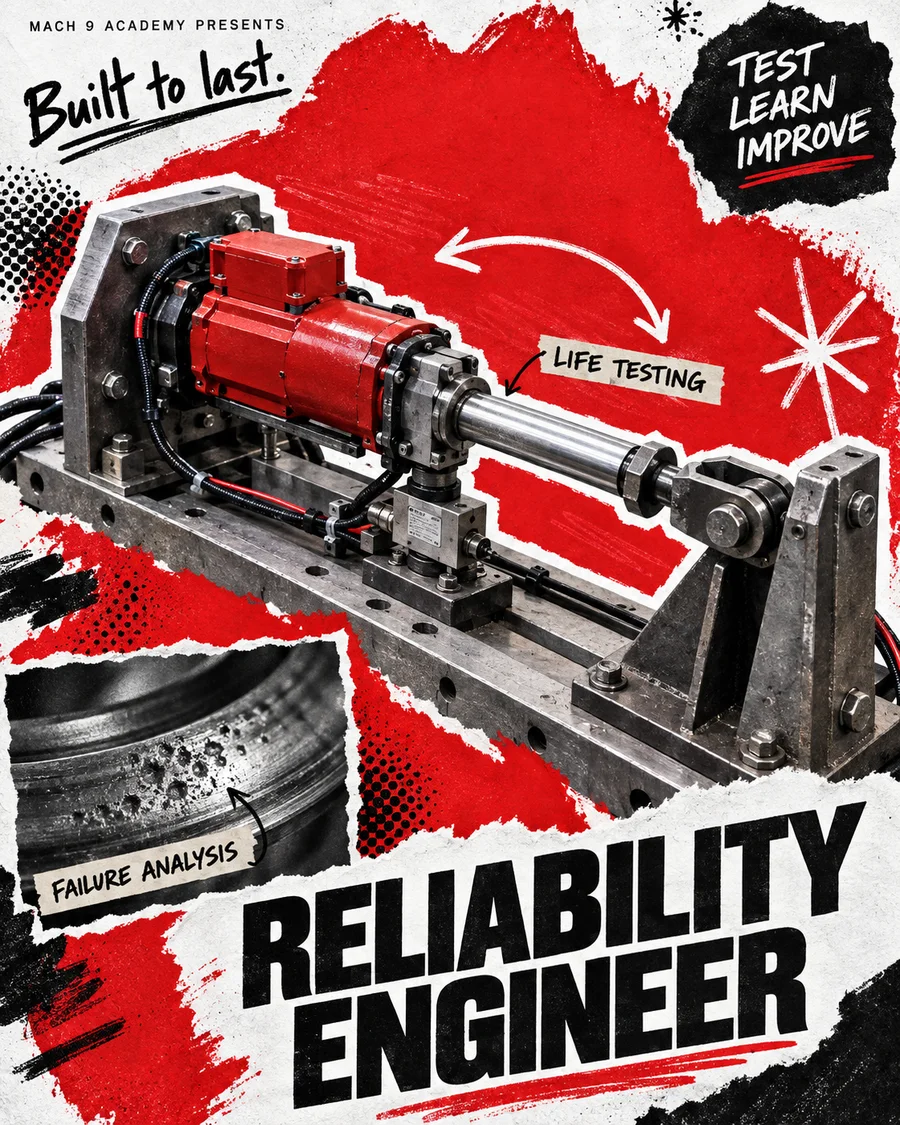
Every part has a failure rate, and reliability engineers turn that uncomfortable fact into something you can design around: failure mode and effects analysis before a part is built, statistical models of how long components actually last, and the forensic investigation that finds a genuine root cause after something breaks in service rather than a plausible-sounding guess. The job sits closer to statistics than to any one piece of hardware.
A typical day
- 01Run failure mode and effects analysis on new designs
- 02Build statistical models of component and system life
- 03Investigate field or test failures back to a genuine root cause
- 04Recommend design or process changes that actually address it
How people get in
- Engineering degree
Mechanical, aerospace or industrial engineering, ideally with a reliability or statistics course beyond the core.
How it unfolds
- DegreeMechanical, aerospace or industrial engineering, with statistics taken further than most courses require.
- Years 1-3Failure mode and effects analysis on parts other engineers designed, and learning to read a fracture surface.
- Years 4-8Owning reliability predictions for a whole system, and leading root-cause investigations when something breaks.
- LaterReliability lead, or into a broader systems safety role.
Is there a job in it
- Employed now
- 298,500
- Projected change
- +11% by 2034
- Openings a year
- 17,800
Mechanical Engineers · US Bureau of Labor Statistics, Occupational Outlook Handbook, May 2024 wages and 2024–34 projections.
Reliability engineering is not tracked as its own occupation. Most reliability engineers are trained mechanical, aerospace or industrial engineers, so this is the closest published figure, for a much larger population than the specialism itself.
The hard parts
A reliability prediction is a probability, not a guarantee, and when the rare failure happens anyway you are the one explaining why the model did not catch it. Root-cause investigation after a real failure comes with real pressure to find an answer fast, and a wrong answer sends the fix in the wrong direction while the real cause keeps failing.
What you would need
- Statistics
- Failure mode and effects analysis
- Root-cause investigation
- Materials and mechanics fundamentals
- Median pay
- $104,110
- Mechanical Engineers, May 2024. US Bureau of Labor Statistics.
- Typical education
- Bachelor's in mechanical, aerospace or industrial engineering
- Routes in
- Degree
- Field
- Engineering