Loading…
Careers · Space
Assembles and tests the rocket and the spacecraft on top of it before either one ever leaves the ground.
The work
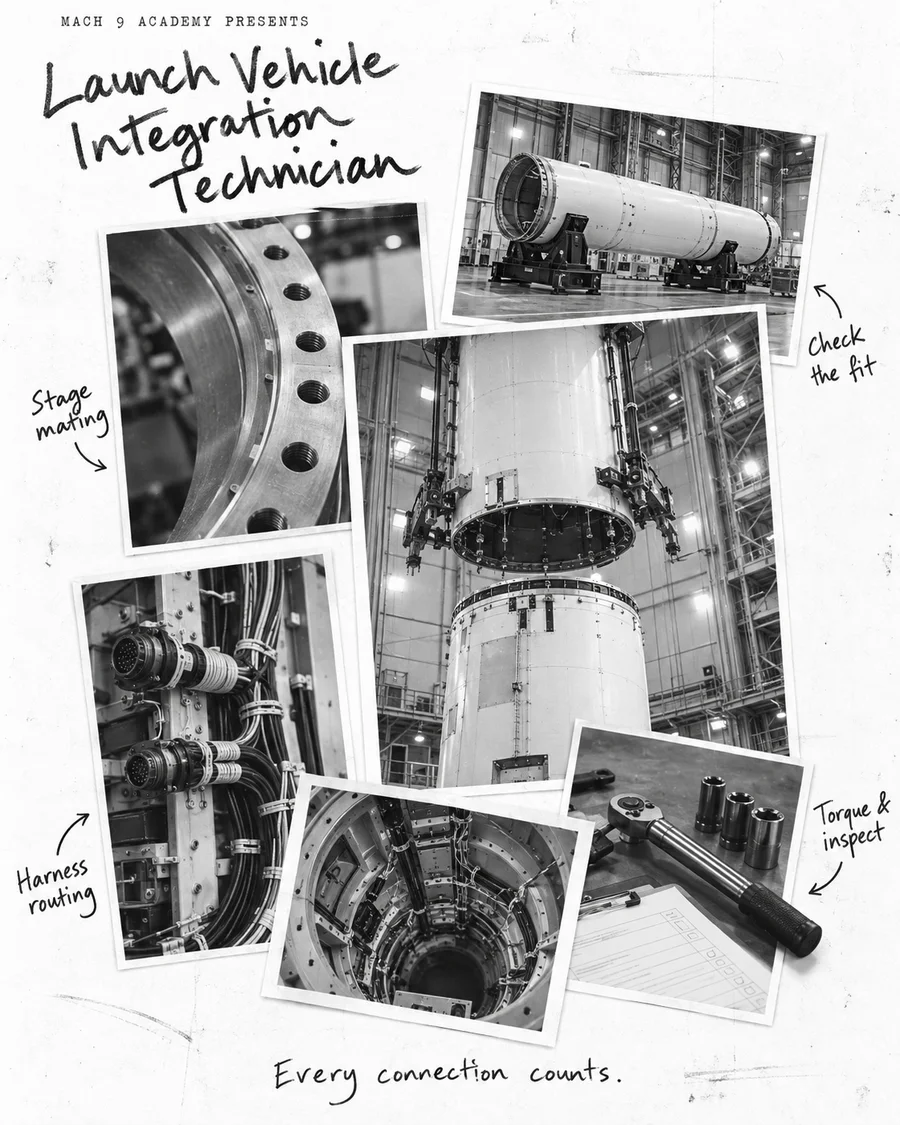
Before a rocket flies, its stages, engines and avionics have to be physically mated, wired, pressure-tested and inspected against a build plan that leaves no step undocumented, and the spacecraft riding on top goes through the same process separately before the two are joined. Integration technicians do that work: torqueing fasteners to a specified value, running continuity checks on harnesses, and signing for each step because the next person’s work depends on trusting that yours was done right.
A typical day
- 01Mechanically mate stages, engines and payloads to a documented build plan
- 02Run continuity and functional checks on wiring and avionics
- 03Work in clean-room conditions and to hazardous-operations procedures
- 04Sign off each step, because the next one depends on it being right
How people get in
- Technical training or associate’s degree
Aerospace or mechanical assembly programmes, often followed by employer-specific vehicle training.
- Military maintenance or ordnance background
Hands-on experience with aircraft, munitions or precision mechanical systems converts well.
How it unfolds
- TrainingTechnical training or an employer apprenticeship in mechanical or aerospace assembly.
- Years 1-3Mechanical and electrical integration work under a lead technician, learning one vehicle in real depth.
- Years 4-8Lead technician on a build, responsible for a whole stage or the final integrated vehicle.
- LaterIntegration manager, or across into manufacturing or systems engineering.
Is there a job in it
- Employed now
- 11,600
- Projected change
- +12% by 2034
- Openings a year
- 1,100
Aerospace Engineering and Operations Technologists and Technicians · US Bureau of Labor Statistics, Occupational Outlook Handbook, May 2024 wages and 2024–34 projections.
The Handbook’s technician occupation covers every aerospace specialism together, aircraft and spacecraft, structures and avionics. Launch vehicle and spacecraft integration specifically is not broken out.
The hard parts
Launch schedules are public and expensive to slip, which puts real pressure on a build, and the discipline of the job is refusing to let that pressure change what a checklist requires. The hardware is often one-of-a-kind or nearly so, a mistake is not just rework, it can be irrecoverable. Clean-room and hazardous-propellant procedures mean suiting up and working carefully even when the job itself is routine.
What you would need
- Precision mechanical assembly
- Reading build and wiring documentation
- Clean-room discipline
- Torque and fastener standards
- Median pay
- $82,890
- Aerospace Engineering and Operations Technologists and Technicians, May 2024. US Bureau of Labor Statistics.
- Typical education
- Associate's degree or technical training in aerospace or mechanical technology
- Routes in
- Apprenticeship, Licence or certification
- Field
- Space