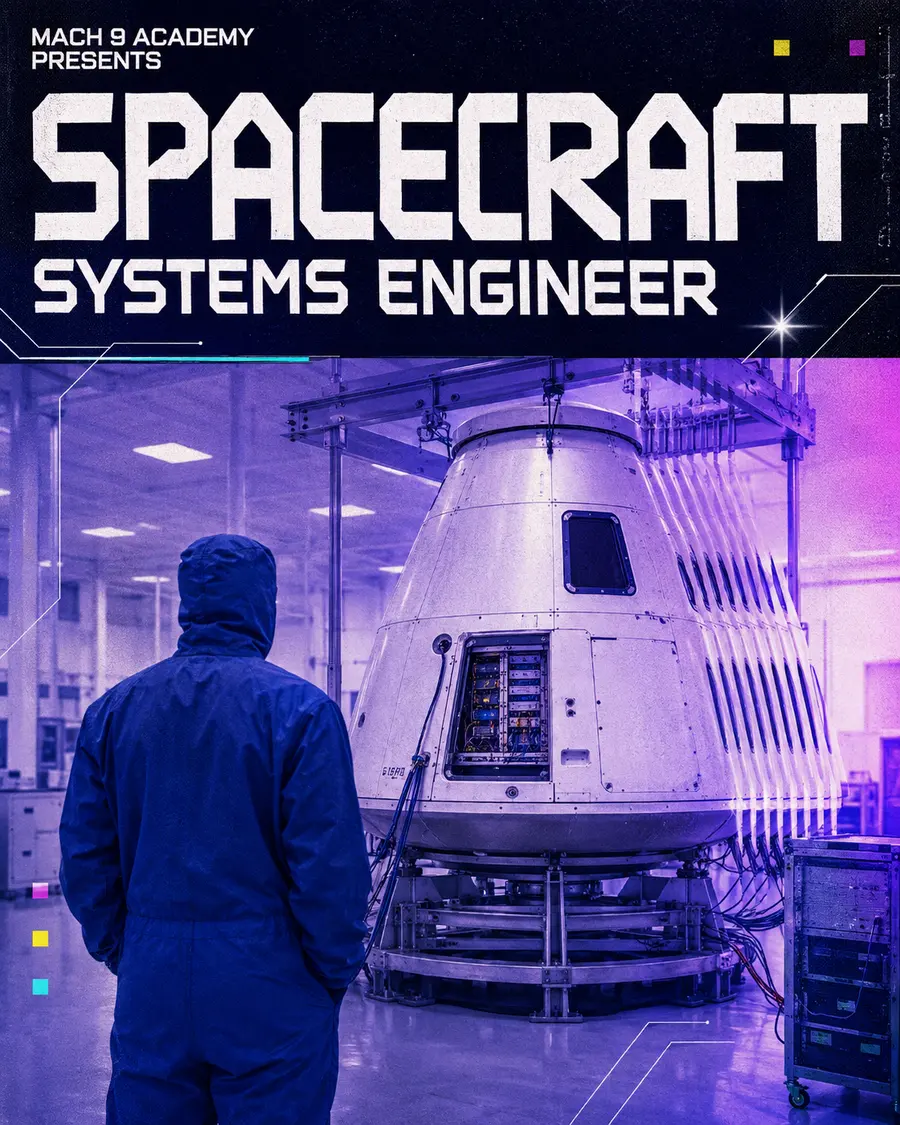
Owns how the whole spacecraft fits together, not any one part of it.
The work
Systems engineering is the discipline of the interfaces. Power, thermal, propulsion, comms, attitude control and payload each have specialists; the systems engineer owns the budgets they all draw on, the requirements they all trace to, and the failure modes that only appear where two subsystems meet. Most of the job is asking hard questions early, because there is no maintenance visit afterwards.
A typical day
- 01Hold the mass, power and data budgets, and say no when they are spent
- 02Trace requirements from the mission down to a connector pin
- 03Run failure analyses and decide what has to be redundant
- 04Chair the review where six specialists disagree
How people get in
- From a subsystem
The usual route. Spend a few years deep in power or thermal, then move outward.
- Systems engineering masters
A direct route, and stronger when it follows some hands-on experience.
How it unfolds
- DegreeAerospace, electrical or systems engineering, usually with a masters somewhere.
- Years 1-4Deep in one subsystem (power, thermal, comms) because you cannot own interfaces you have never built.
- Years 5-9Systems: the budgets, the requirements, the failure analyses, and chairing the argument.
- LaterChief engineer or mission architect.
Is there a job in it
- Employed now
- 68,700
- Projected change
- +8% by 2034
- Openings a year
- 3,800
Aerospace engineers · US Bureau of Labor Statistics, Occupational Outlook Handbook, May 2024 wages and 2024–34 projections.
Counted inside "aerospace engineers", along with every other engineering discipline that works on air and space vehicles. There is no separate published line for this specialism.
The hard parts
You are responsible for everything and expert in nothing, which is uncomfortable for a long time. There is no maintenance visit after launch, so a question you did not ask early becomes a mission you cannot fix. Reviews are where careful work meets six specialists who all want something different.
What you would need
- Requirements and interface management
- Failure mode analysis
- Enough of every subsystem to ask the right question
- Written precision
- Median pay
- $134,960
- Aerospace engineers, May 2024. US Bureau of Labor Statistics.
- Typical education
- Bachelor's or Master's in aerospace, electrical or systems engineering
- Routes in
- Degree
- Field
- Space